
Post-Top Lighting and Dark Sky Compliance
Post-top luminaires enhance the evening ambiance of neighborhoods, downtowns, campuses, and parks while also being an important topic in light pollution discussions. With an increasing number of municipalities implementing dark sky ordinances, one question always arises in streetscape projects: can a decorative post-top light fixture be both beautiful and dark sky-compliant? The typical answer is yes, but the details make the difference. Luminaire style, optical design, shielding, and color temperature determine how much light is emitted upward to the sky and how much is emitted downward to the ground. This paper will introduce you to the concept of post-top lighting and dark sky compliance, outline the movement’s history, list design characteristics that contribute to compliance, and summarize pertinent regulations, including the recent Palo Alto ordinance.
Definition of a Post-Top Light
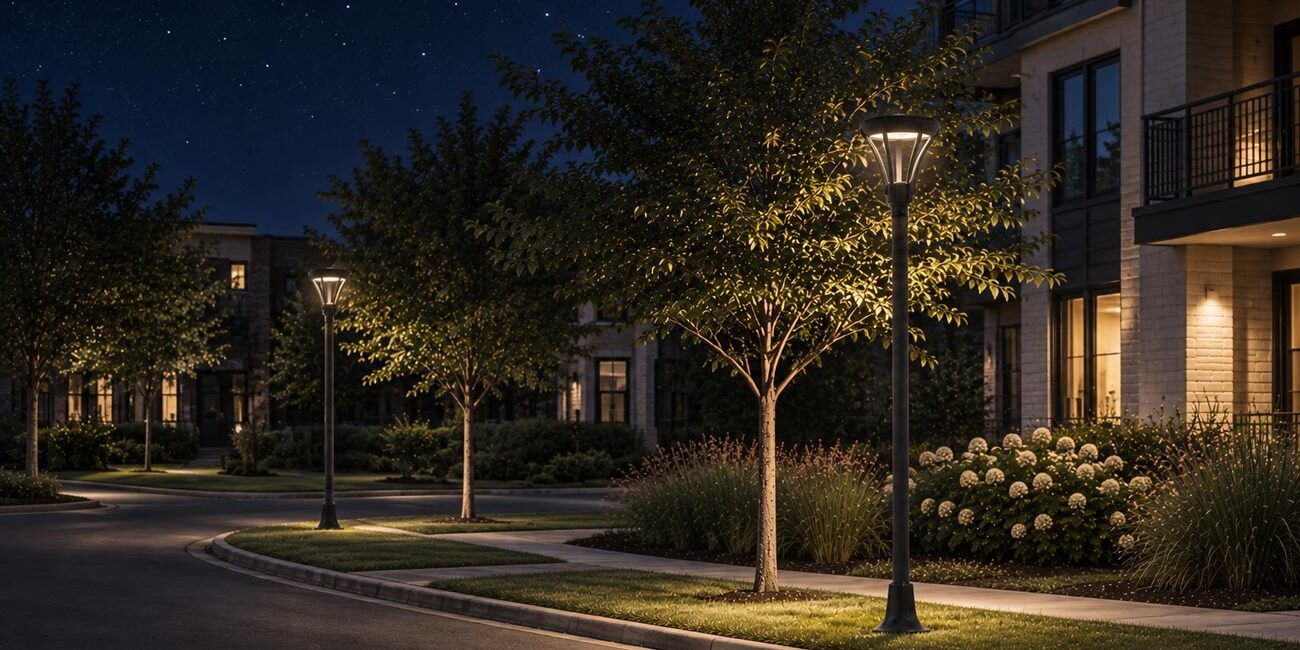
A post-top light is an outdoor luminaire mounted on top of a pole, usually on a tenon that fits into the pole’s top. Post-top luminaires are usually mounted on poles 3 to 6 meters high, illuminating sidewalks, streets, parks, and pathways at human scale. Unlike tall cobra-head road luminaires, post-top fixtures are valued both for form and functionality. Post-top design styles range from classic acorns and lanterns to modern cylinders and cubes, and are often mounted on decorative poles, bases, and finials to create a streetscape.
Contexts Where Post-Top Lighting is Used
Post-top lighting is popular in residential areas, apartment complexes, downtowns, business parks, campuses, parks, and shopping centers.
Importance of Post-Top Lighting for Light Pollution
Because of their widespread use in residential and public spaces, post-top luminaires affect glare, light trespass, and skyglow through their optical design and shielding.
Definition of Dark Sky Compliance
Dark sky compliance is the process of adhering to the best practices of outdoor lighting that reduce light pollution by providing lighting only where and when it is needed and at an appropriate level. Dark Sky International (formerly the International Dark-Sky Association) is the primary governing body in this area, with its Dark Sky approved program certifying luminaires that meet all requirements. To become Dark Sky approved, a luminaire should be fully shielded, emit no light above the horizontal line, be fixed to prevent upward tilt, and have a color temperature of 3000 K or lower.
Issues Addressed by Dark Sky Lighting
- Skyglow – illumination of the sky caused by light scattering in the atmosphere.
- Glare – situations where visual performance is hindered by excessive light levels.
- Light trespass – the spillage of light onto adjacent property or into windows.
- Impact on wildlife – negative consequences for nocturnal and migratory birds and wasted energy due to inappropriate lighting direction.
Shielding, Uplight and BUG Ratings
A fully shielded luminaire emits no luminous flux above the horizontal plane. Lighting specialists evaluate the extent of shielding using the BUG rating system, which stands for Backlight, Uplight, and Glare. Every component of the rating system is measured from 0 to 5, with the uplight being U0 if no light is emitted above. Maximum ratings allowed by ordinances vary by lighting zone, with stricter limits in areas that need more protection (parks, rural communities) and greater latitude in dense urban settings.
A Brief History of Dark Sky Lighting
Light pollution concerns existed long before LED technology. The first outdoor lighting ordinance was created in 1958 in Flagstaff, Arizona. Astronomers at Lowell Observatory worked with the city to restrict overly intense lighting that obscured the night sky, including advertising searchlights. International Dark-Sky Association (now Dark Sky International) was founded in 1988 by astronomer David Crawford and physician Tim Hunter to advocate for responsible outdoor lighting practices. In the late 1980s, Flagstaff and Coconino County adopted some of the strictest lighting codes of the time. In 2001, Flagstaff received the title of the world’s first International Dark Sky City. In 2011, Dark Sky and the Illuminating Engineering Society developed the Model Lighting Ordinance, which based all requirements on the BUG rating and served as a model for local code development. The spread of LED street lights brought back more issues because, although LEDs provide highly efficient illumination, high-color-temperature fixtures emit more blue light, necessitating new ordinances that control not only shielding but also color temperature.
Which Post-Top Styles Allow for Dark Sky Compliance?
Post-top style alone doesn’t determine compliance. Optical design, shielding, and the direction of the light engine are just as important as post-top style. But in general, certain styles allow for compliance better than others.
Styles With Higher Chance of Compliance
- Acorn and lantern style with the opaque cap/roof and downward-facing light source.
- Fixtures with sag/drop lenses enclosed in the fully shielded housing.
- Modern cylinder and cube shapes with flat lenses and integrated optics emitting light downwards and to the sides.
- Fixtures with internal reflectors or refractors that allow control of light distribution on targets.
This type of design keeps the light source hidden behind an opaque covering, preventing any light from escaping upward.
Styles That Need More Attention
Classic globes, clear or exposed lenses, and lanterns with upward-facing glass emit light in multiple directions, potentially creating uplight and glare. Some lighting manufacturers recommend avoiding these fixtures when implementing strict dark sky requirements.
This assessment doesn’t exclude a classic look. Fully shielded, downward-facing light engines, louvers, and optical refractors can eliminate uplight from the fixtures, preserving a traditional appearance. While some ordinances allow decorative or historic lighting, many don’t; it is necessary to consult the local code.
Ask for Photometric Information
The most reliable way to evaluate a fixture is to use figures rather than aesthetics. Request the BUG rating, the photometric (IES) file, and the Dark Sky Approved status, if applicable. The up-to-light rating should be U0.
Light Color Temperature and the Night Sky
Color temperature, expressed in Kelvin (K), indicates whether the white light is warm or cool, with lower numbers being warmer and more amber, and higher numbers being cooler and bluer. Blue light scatters more in the atmosphere and affects wildlife and human sleep more, which is why warmer lighting is preferred in dark sky guidelines.
Typical benchmarks include:
- Dark Sky Approved luminaires: 3000K or lower.
- Palo Alto, CA: no higher than 2700K.
- Medina, WA and Poway, CA: 3000K or lower.
- McDonald Observatory (Texas): recommendations of 2000K, 2200K, or 2700K.
- Wildlife-sensitive areas (coastal areas): amber sources may be required.
Combining Warm Lighting and Visibility
Warm lighting doesn’t mean dim streets. Walkers and drivers need sufficient illumination; therefore, color temperature should be evaluated alongside lumens, optical design, mounting height, and spacing. Dimming and timing controls are used to reduce lumens during low-activity periods and become increasingly important with the adoption of ordinances.
Dark Sky Regulations Pertaining to Communities
There is no national legislation regulating dark sky practices. Regulatory requirements stem from a mix of local ordinances and state laws, and they can vary widely.
Palo Alto, California
On December 8, 2025, Palo Alto’s City Council adopted an updated Lighting Ordinance that aligned city policy with Dark Sky principles, and it became effective in February 2026. The ordinance requires full shielding, reduced brightness levels, a 2700K color temperature limit, and a lighting curfew. Essential safety lighting is exempted. Adjustable lighting installations should be brought into compliance with the new standards within 1 year of the effective date, except for shielding requirements.
Other Local Ordinances
Many other cities have enacted similar provisions. The city of Medina, WA, enacted Ordinance 1058, effective from August 4, 2026, requiring luminaires to be shielded, downward-facing, with 3000K or lower color temperature, and a lighting schedule should be included in the building permit application listing the color temperature of every fixture. Poway, CA, similarly restricts color temperature to 3000K. Cupertino and Brisbane, CA, implement dark sky guidelines for new and replacement lighting; Flagstaff is one of the cities with the most established lighting ordinances in the country.
State Legislation
In at least nineteen states, the District of Columbia, and Puerto Rico, light pollution-reducing laws have been adopted. These laws concern lighting fixtures on state property and along public roads. The most common requirement is the use of fully or partially shielded lighting fixtures directing light downwards only. For example, in Arizona, outdoor lighting must be fully or partially shielded, but with exemptions. In Texas, state law sets standards for the state-funded outdoor lighting fixtures. In the seven counties around McDonald Observatory, a lighting ordinance should be maintained.
Model Lighting Ordinance
The jointly developed Model Lighting Ordinance by DarkSky and the Illuminating Engineering Society remains a widely used basis for ordinances. It uses lighting zones and BUG (Backlight, Uplight, Glare) ratings to adapt requirements to the character of the area, and many local ordinances incorporate parts of this system.
Planning Post-Top Lighting With Dark Sky Requirements
- Review local and state lighting codes before choosing the fixtures, including the requirements for existing, new, and replacement lighting.
- Request BUG ratings and photometric files, and check if there is a U0 uplight rating.
- Choose color temperature within the local permissible range, keeping in mind that 3000K is usually the upper limit and 2700K can be the stricter standard.
Dimming and timing controls can be used to reduce luminosity during periods of low activity. Downward optics and opaque tops of the fixtures, including decorative ones, are advised. It is important to plan for future regulation changes as many cities tighten their ordinances.
Brandon Industries offers decorative post-top luminaires, globes, LED lamps, and light engines, as well as full solutions for light poles in communities across North America. The H-01S Modern Post Top Luminaire is a DARK SKY-certified product. Brandon Industries also offers multiple DARK SKY certified lighted bollards, such as the B-SQ.
Contact us for more information about our fixtures and photometric data, or connect with one of our lighting representatives.
Frequently Asked Questions About Post-Top Lighting and Dark Sky Compliance
What is a post-top light?
A post-top light is an outdoor luminaire mounted on the top of a pole. Usually mounted on poles 3 to 6 meters high, these fixtures illuminate sidewalks, streets, plazas, and pathways and are often designed in decorative styles such as acorns and lanterns.
What is meant by dark-sky-compliant lighting?
Dark sky-compliant lighting means reducing light pollution through fully shielded fixtures that don’t emit light above the horizontal plane, providing light only where and when it is needed, at appropriate levels. Dark Sky approved luminaires are fully shielded, fixed to prevent tilt, and have a correlated color temperature of 3000 K or lower.
Can decorative acorn or globe post-top lights be Dark Sky compliant?
Yes, but it depends on the design. Acorn and lantern styles with opaque caps and downward-facing light sources can be easier to adapt to meet compliance requirements. Globe fixtures and exposed lenses need internal shielding or optics control to eliminate uplight. Some local ordinances prohibit the use of this kind of fixture. It is necessary to check the fixture’s BUG rating and photometric data.
What color temperature is best for dark sky lighting?
Warmer temperatures are preferred. Dark Sky Approved luminaires must be 3000 K or lower, and some ordinances, such as in Palo Alto, limit color temperature to 2700 K. Amber light sources are often required in wildlife-sensitive areas.
What is a BUG rating?
BUG rating is the classification of a luminaire according to Backlight, Uplight, and Glare, each rated from 0 to 5. U0 means no uplight is emitted. Many ordinances establish maximum BUG ratings depending on the lighting zone.
Does dark sky lighting impact street safety?
Principles of dark sky lighting include ensuring illumination is present where and when needed, at appropriate levels. Shielding ensures that the light is directed to pedestrian and vehicular ways, and many ordinances have provisions for essential safety lighting.
Is there a national dark sky law?
No. There is no national legislation regulating outdoor illumination. The regulation requirements come from local ordinances and state laws, with at least 19 states adopting light pollution-mitigating laws.
Are the existing street lights required to be changed to meet dark sky standards?
The requirement depends on the ordinance. While some ordinances cover only new and replacement lighting, some have deadlines for existing fixtures. For example, Palo Alto has a one-year deadline for existing adjustable lighting.